Hypnosis for sports · Performance
Hypnosis for Sports Performance: How It Works and What the Research Shows
What hypnosis for sports performance is, how a session works, what it can and cannot help with, and what the research does and does not show.
What is hypnosis for sports performance?
Hypnosis for sports performance is mental training that uses hypnosis, a state of focused attention, to help athletes rehearse calm, confident, focused responses and change the automatic reactions that get in their way under pressure. It is not about making an athlete stronger or faster. It targets what happens between the ears when the game is on the line: the tension, the doubt, the replaying of mistakes.
In Robert Barnett’s practice it is never used alone. Hypnosis is combined with cognitive behavioral techniques, NLP methods, visualization and subconscious pattern work, and shaped around the athlete’s sport and position.
How does it work?
Most pressure reactions, such as freezing, rushing, overthinking or going blank, are automatic habits that run below conscious thought. That is why willpower and positive thinking rarely fix them. Hypnosis aims to work at that level: in a focused, relaxed state, the athlete rehearses the response they want so it is easier to reach in the moment. Cognitive techniques address the thoughts that feed doubt, and routines and resets turn the work into something usable in competition.
What does a session look like?
- Free 20-minute phone consultation. You talk through what happens when you compete and whether this is a fit. There is no obligation.
- Map your pressure moments. Serving at set point, a penalty, the first minute, the play after a mistake.
- Rehearse a better response. Hypnosis and guided visualization, done at rest, one-on-one by Zoom.
- Take a routine into competition. A pre-performance routine, a focus cue and a short reset for after errors.
Sessions are private and one-on-one by Zoom, so they fit around training and travel. They are always done at rest, never while playing or in a sport setting, and you stay in charge throughout.
What can it help with?
- Performance anxiety and pre-game nerves
- Replaying mistakes and bouncing back after errors
- Playing well in practice but tight in games
- Confidence after a slump or setback
- Mental blocks around a skill, such as the yips or a tumbling block
- Focus, routines and pressure moments such as free throws, serves or penalty kicks
It does not replace your coach, technical training, or medical or mental health care.
What does the research say?
The research is encouraging but limited, and it is worth being clear about both sides:
- A randomized controlled trial of 59 college athletes found better performance and self-efficacy on a soccer task after hypnosis compared with an active-control group, with gains still present four weeks later among athletes who returned for follow-up. View the study
- A 2025 systematic review of 13 studies of hypnosis in athletes found significant associations between hypnosis and better athletic performance, less psychological distress and better injury-recovery outcomes. Most studies were small and uncontrolled. View the review
- A 2025 meta-analysis of 86 studies found that mental imagery practice improved athletic performance, and that imagery combined with other psychological skills worked better than imagery alone. The authors rate the evidence quality as low. View the meta-analysis
- A 2026 meta-analysis of 33 randomized controlled trials (1,848 participants) found that structured self-talk produced a moderate improvement in sport performance (Hedges’ g = 0.52), with possible small-study effects and a call for caution. View the meta-analysis
No one can promise a result, and individual experiences vary.
Is it for my sport?
Robert works with athletes in nearly every sport, from youth and high school through college, professional and masters level. Find your sport:
- Golf, tennis, baseball and softball, soccer
- Gymnastics, cheer, volleyball, basketball
- Lacrosse, hockey, football, wrestling and combat sports, swimming and water polo
- Equestrian, motorsport, college and high school athletes
What about parents?
For athletes under 18, a parent or guardian contacts Robert first for the free consultation. Robert has worked with athletes as young as 6 and finds engagement with the work becomes more consistent around ages 8 to 10.
Read the full athlete coaching overview, or read why athletes tighten up in our guide to sports anxiety.
The High Performance Hypnotherapy process. Every program combines hypnosis with CBT techniques, NLP methods, visualization and subconscious pattern work, is built around your specific situation, and is led personally by Robert Barnett. You leave with practical tools, such as a routine and a reset, and receive a detailed written recap by email after every session.
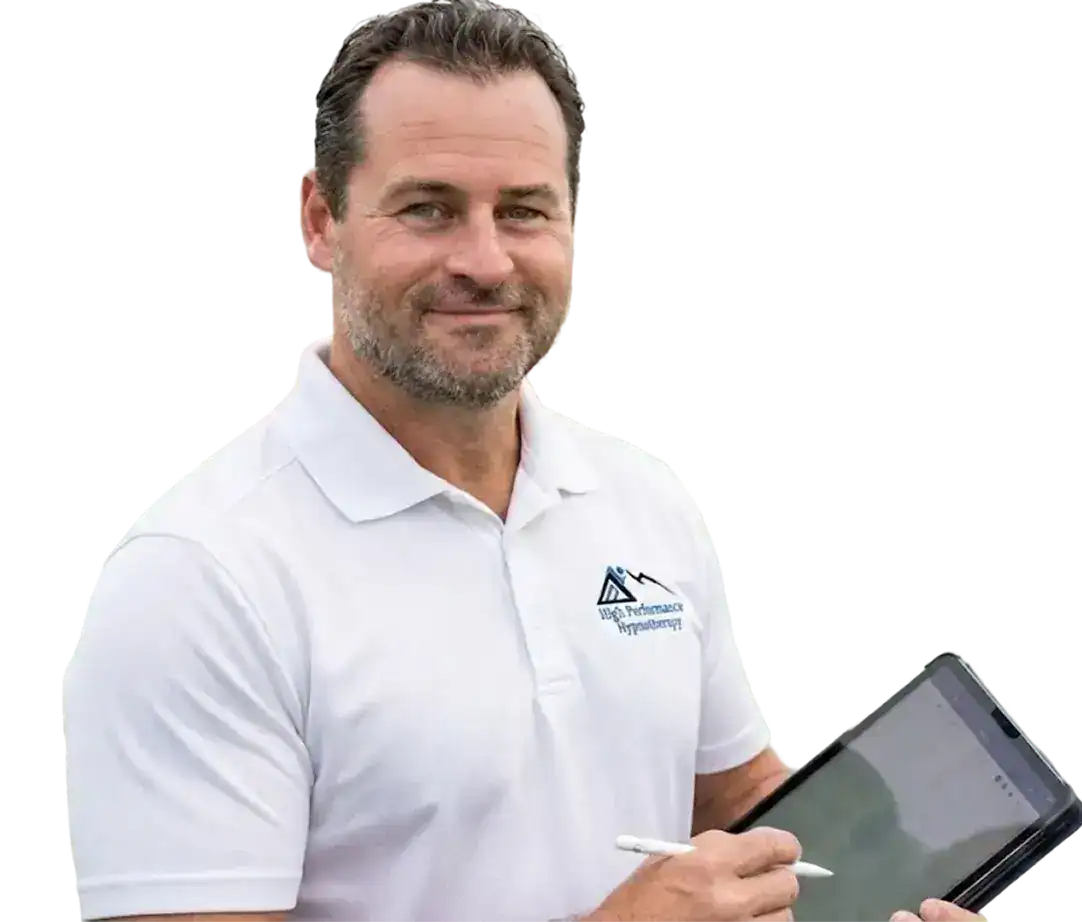
Robert Barnett, C.Ht., PMP, MBA is a certified hypnotherapist and mental performance coach in Trumbull, CT, with 35+ years of hypnosis experience. He works one-on-one by Zoom with athletes, executives and business owners worldwide. About Robert
This article is for general education. It is not medical or mental health advice and does not replace care from a doctor or licensed clinician. Mental coaching complements, and does not replace, your coach’s training. Results vary.
Common questions
Frequently asked questions
Does hypnosis improve athletic performance?
Research is encouraging but limited. A randomized trial of 59 college athletes found better performance after hypnosis, and a 2025 review of 13 studies found associations with better performance, but most studies were small and uncontrolled. No one can promise a specific result.
What is hypnosis for athletes?
It is mental training using hypnosis, a state of focused attention, together with CBT techniques, NLP methods and visualization to help athletes stay calm, focused and confident under pressure.
Is sports hypnosis safe?
Hypnosis is a state of focused attention, and you stay in charge throughout. Sessions are done at rest, never while playing. It does not replace medical or mental health care.
How many sessions do athletes need?
It depends on your goals, sport and how much you practice between sessions. Robert offers three program lengths and recommends one after the free consultation.
Do you work with youth athletes?
Yes. For athletes under 18, a parent or guardian contacts Robert first for the free 20-minute phone consultation. Robert has worked with athletes as young as 6.
Do I need to be in Connecticut?
No. Sessions are one-on-one by Zoom, and most clients work with Robert remotely. His practice is based in Trumbull, CT.
Free consultation
Ready to compete with a clear head?
Call (203) 816-0015 for a free 20-minute phone consultation, or contact us here. Sessions are one-on-one by Zoom, from anywhere.
Call for a free consultation