
Volleyball mental performance
Mental Coaching for Volleyball Players
Private sessions by Zoom for hitters, setters, liberos and defensive specialists, from club and high school through college and beyond, to help them serve with confidence, reset after errors and play free under pressure. Parents are welcome to start the conversation.
Book my free consultation20 minutes · No cost · No obligation

Work directly with Robert BarnettCertified Hypnotherapist · C.Ht., PMP, MBA

Free 20-minute consultation
No cost · No obligation · By phone
Volleyball is a game of short rallies, constant rotation and momentum swings, with a pause between every point where doubt can creep in. One missed serve, a shanked pass or a blocked attack can follow you through the next rotation, and a run by the other side can make the whole team tighten up. The players who last are the ones who can let the last point go and compete on the next one. Mental coaching and hypnosis train the skills that hold up under that pressure: staying present, resetting quickly and trusting your preparation. Robert Barnett, C.Ht., PMP, MBA, is a certified hypnotherapist and mental performance coach with 35+ years of hypnosis experience. He works with volleyball players, along with athletes in nearly every sport. Players of every position are welcome, including setters, liberos and defensive specialists, and younger players are too. He works with players and their parents by Zoom from anywhere.
When the mental side matters
Sound familiar?
Volleyball players who:
Serving under pressure
Tighten up at the service line, steer the ball or play it safe because a missed serve feels too costly, especially late in a set.
Replaying the error
Miss a serve, shank a pass or get blocked and replay it through the next rally and the next rotation.
Hitters who press
Swing harder or hesitate after being blocked, and lose the rhythm that made you effective earlier in the match.
Setters and liberos carrying the team
Feel responsible for every decision or every first touch, with the whole offense depending on you and every mistake in public view.
Strong in practice, tight in matches
Look confident in practice, then tense up when the match, the tournament or the scouts are watching.
Tryout and recruiting pressure
Feel the weight of club tryouts, playing time, recruiting and the expectations of coaches, teammates and family.
The pattern behind it
Why practice doesn’t always carry into matches
In practice, the stakes are low, so you play on trained habit. In a match, with a scoreboard, a crowd and a coach watching, the same serve or swing can feel like a threat, and an automatic stress response takes over: tension, rushed decisions, doubt. Drills, conditioning and technique improve your game, but they do not change that response, because it runs below conscious thought. That gap is what mental coaching works on.
In Robert’s experience, many players focus on the result, such as the score, the run or who is watching, and performance tends to improve when attention shifts to the process: what you can control, one point at a time.
The mental game plan
The solution: a mental plan built around your position
The work usually follows three steps, shaped around your position, your season and your goals:
Map your pressure moments
We pin down when and where your game changes: serving at set point, passing against a tough server, the minutes after a run by the other side, or coming in as a substitute.
Rehearse a better response
Hypnosis and guided visualization work at the subconscious level, where automatic reactions live, so you can rehearse the focus and composure you want before you are in the moment.
Take a routine to the court
You leave with a pre-serve routine, a focus cue and a short reset you can use after an error, a block or a lost point.
Hypnosis is a state of focused attention, and it is one tool among several. Most pressure reactions, such as freezing, rushing or overthinking, are automatic habits that run below conscious thought, which is why willpower and positive thinking rarely fix them. We combine hypnosis with complementary methods: cognitive behavioral techniques (CBT) to identify and restructure the thoughts that feed doubt, NLP methods to change how you picture and respond to pressure situations, and subconscious pattern work to replace old reactions with new ones. In Robert’s experience, combining them gets results more quickly than any one alone. It is not mind control, and you stay in charge throughout.
Visualization is a core skill we teach, and we use it inside hypnosis. Research supports pairing skills: a 2025 meta-analysis of 86 studies found that imagery works better when combined with other psychological skills, which is why we pair it with hypnosis and cognitive tools.
Sessions are one-on-one by Zoom, so they fit around practice, school and travel. Everything is built around your position and the situations that trip you up. Robert offers three program lengths and recommends one after your free phone consultation.
You start with a free 20-minute phone consultation. We talk through what happens when you play matches and whether this is a fit. Your sessions are then held one-on-one by Zoom.
Mental coaching complements your coach’s training. It is not technical or tactical instruction in volleyball, and it does not replace medical or mental health care. Progress is individual; results vary.

Your position. Your season.
Win the
next point.
Every player’s pressure points are different. The work is built around your position, your schedule and the situations that trip you up.
- A pre-serve routine you can repeat
- A quick reset after an error or a lost point
- A plan for big matches, tournaments and tryouts
For parents and guardians
How it works for players under 18
For players under 18, a parent or guardian contacts Robert first. The free 20-minute phone consultation is a chance to talk about your player’s goals, whether the timing is right, and how sessions would work. The details of parent involvement are discussed there.
Robert has worked with athletes as young as 6 in several sports, and finds that engagement with the work becomes more consistent around ages 8 to 10. Sessions are private, one-on-one by Zoom, and fit around school and practice. You will get a clear plan for what to expect, and no obligation to continue.
In their words
What athletes and parents say
High Performance Hypnotherapy has 65+ five-star reviews on Google. The reviews below are quoted as posted by athletes and parents across several sports. Individual experiences vary and results are not guaranteed.
“Robert is dedicated and professional. He provides a weekly email, where he recaps his session with my daughter in a very detailed manner. His invaluable insights helped my daughter overcome her sports/performance related fears. We hope our daughter uses the tools she has learned throughout her sports career and in all aspects of her life.”
Parent of a young athlete, Google review, 5 stars
“Dr. Barnett’s services are truly life-changing and I would recommend them to everyone. Over the course of 5 sessions, Dr. Barnett helped me rebuild how I mentally approach every part of my life. I am happier, more focused and performing better in sports, school and beyond as a result of his work.”
Student-athlete, Google review, 5 stars
“At first I was very open minded yet skeptical, but from the moment I talked to Dr. Robert I realized why hypnotherapy and how high performance coaching processes the information is a major advantage in reaching your goals.”
Student-athlete, Google review, 5 stars
More client stories are on our client reviews page.
Meet your mental coach
About Robert Barnett
Robert Barnett is a certified hypnotherapist (C.Ht.) with a PMP and an MBA. He has practiced hypnosis for more than 35 years and runs High Performance Hypnotherapy from Trumbull, CT, working with executives, business owners and competitive athletes worldwide, including college and high school athletes. Learn more about Robert. Robert competed at a high level himself and knows sports anxiety from the inside: it built through years of competition in high school and college, with teammates counting on him and his name known across campus. He has worked with athletes in nearly every sport, from youth and high school to college and professional levels, and the conversation begins with your experience and the change you want to make.
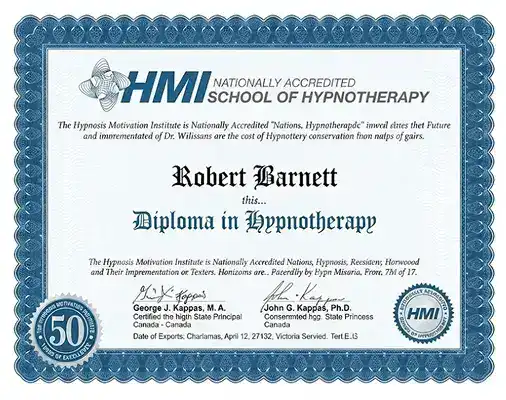 HMI · Diploma in Hypnotherapy
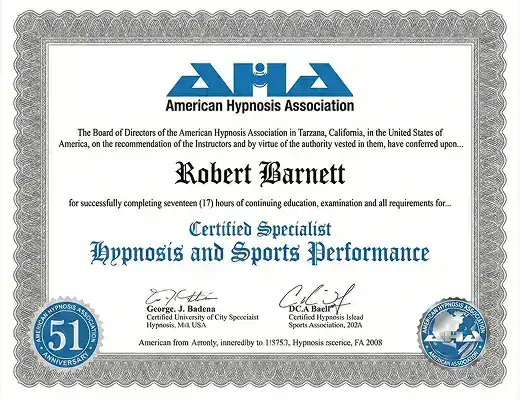 Sports Performance Training