
Tennis mental performance
Mental Coaching for Tennis Players
Private sessions by Zoom for junior, college and adult competitive tennis players, to help them handle big-point pressure, stay composed between points and play their best when the match is close. Parents are welcome to start the conversation.
Book my free consultation20 minutes · No cost · No obligation

Work directly with Robert BarnettCertified Hypnotherapist · C.Ht., PMP, MBA

Free 20-minute consultation
No cost · No obligation · By phone
Tennis is one of the most mentally demanding sports. You compete alone, the score swings on a handful of points, and there is time to think between every one of them, which is where doubt gets in. Most matches are played without a coach on court, so you have to manage your own head. Mental coaching and hypnosis train the skills that hold up under that pressure: staying present, resetting after an error or a bad call, and playing the next point instead of the last one. Robert Barnett, C.Ht., PMP, MBA, is a certified hypnotherapist and mental performance coach with 35+ years of hypnosis experience. He has worked with competitive tennis players at every level, including numerous Division I college players and professionals, along with juniors and adult competitors, and with athletes in nearly every sport. Younger players are welcome too. He works with players and their parents by Zoom from anywhere.
When the mental side matters
Sound familiar?
Tennis players who:
Tighten up on big points
Play freely until the score gets close, then the arm tightens, the serve shortens and the match slips away.
Practice player, match-day struggle
Hit great in practice and with friends, but become a different player when the result counts.
Serve anxiety and double faults
Rush the motion, doubt the toss or fall apart on second serves, and every service game feels like a risk.
Frustration after errors and bad calls
Let one mistake or one line call turn into a bad game, then a bad set, and lose the plan.
Pressure from rankings and expectations
Feel the weight of ratings, rankings, recruiting and the hopes of coaches and family.
Slumps and lost confidence
Carry a losing streak or a return from injury into every match, until doubt is louder than the plan.
The pattern behind it
Why practice doesn't always carry into matches
In practice, the stakes are low, so you hit on trained habit. In a close match, the same shot can feel like a threat, and an automatic stress response takes over: tension, rushed decisions, doubt. Lessons and drills improve your strokes and fitness, but they do not change that response, because it runs below conscious thought. That gap is what mental coaching works on.
In Robert's experience, many players are focused on the result, such as the score, the ranking and who is watching, and performance tends to improve when attention shifts to the process: what you can control, one point at a time.
The mental game plan
The solution: a mental plan built around your game
The work usually follows three steps, shaped around your game, your tournament schedule and your goals:
Map your pressure moments
We pin down when and where your game changes: serving at 5-4, break points, tiebreaks, after a bad call, or against a certain opponent.
Rehearse a better response
Hypnosis and guided visualization work at the subconscious level, where automatic reactions live, so you can practice the focus and composure you want before you are in the moment.
Take a routine into competition
You leave with a between-points routine, a focus cue for your serve and a reset you can use after an error or a bad call.
Hypnosis is a state of focused attention, and it is one tool among several. Most pressure reactions, such as freezing, rushing or overthinking, are automatic habits that run below conscious thought, which is why willpower and positive thinking rarely fix them. We combine hypnosis with complementary methods: cognitive behavioral techniques (CBT) to identify and restructure the thoughts that feed doubt, NLP methods to change how you picture and respond to pressure situations, and subconscious pattern work to replace old reactions with new ones. In Robert's experience, combining them gets results more quickly than any one alone. It is not mind control, and you stay in charge throughout.
Visualization is a core skill we teach, and we use it inside hypnosis. Research supports pairing skills: a 2025 meta-analysis of 86 studies found that imagery works better when combined with other psychological skills, which is why we pair it with hypnosis and cognitive tools.
Sessions are one-on-one by Zoom, so they fit around practice, classes and travel. Everything is built around your game and the situations that trip you up. Robert offers three program lengths and recommends one after your free phone consultation. In Robert's experience, the shortest is a starting point, since skills that hold up in competition usually take longer to build.
You start with a free 20-minute phone consultation. We talk through what happens when you play matches and whether this is a fit. Your sessions are then held one-on-one by Zoom.
Mental coaching complements your coach's training. It is not technical instruction in tennis, and it does not replace medical or mental health care. Progress is individual; results vary.

Your game. Your match.
Play the next
point.
Every player's pressure points are different. The work is built around your game, your schedule and the situations that trip you up.
- A between-points routine you can repeat
- A reset for errors, bad calls and bad games
- A plan for big matches, tiebreaks and tournaments
For parents and guardians
How it works for players under 18
For players under 18, a parent or guardian contacts Robert first. The free 20-minute phone consultation is a chance to talk about your player's goals, whether the timing is right, and how sessions would work. The details of parent involvement are discussed there.
Robert has worked with athletes as young as 6 in several sports, and finds that engagement with the work becomes more consistent around ages 8 to 10. Sessions are private, one-on-one by Zoom, and fit around school and practice. You will get a clear plan for what to expect, and no obligation to continue.
In their words
What players and parents say
High Performance Hypnotherapy has 65+ five-star reviews on Google. The reviews below are quoted as posted by athletes and parents across several sports; the first three are from tennis players and the parent of a tennis player. Individual experiences vary and results are not guaranteed.
“I had a fantastic experience with Rob. I am a professional athlete and been struggling with my mindset and mental performance on the court. Rob has provided me with amazing tools that added a lot of clarity and confidence to my process… We had about five sessions together and I have noticed an improved consistency and confidence in my game.”
Professional tennis player, Google review, 5 stars
“Phenomenal. All star assistance. My son is a five star athlete who needed extra support during a critical time and this intervention made all the difference. Highly effective and could not recommend highly enough…”
Parent of a competitive tennis player, Google review, 5 stars
“My play and on court experience has become so much more positive than before. Our work together has also benefited me in my personal life by tangibly increasing a sense of calm. The program and its practice has me trusting, embracing and enjoying the process to a greater level than before.”
Competitive amateur tennis player, Google review, 5 stars
“Robert is dedicated and professional. He provides a weekly email, where he recaps his session with my daughter in a very detailed manner. His invaluable insights helped my daughter overcome her sports/performance related fears.”
Parent of a young athlete, Google review, 5 stars
“Dr. Barnett’s services are truly life-changing and I would recommend them to everyone. Over the course of 5 sessions, Dr. Barnett helped me rebuild how I mentally approach every part of my life. I am happier, more focused and performing better in sports, school and beyond as a result of his work.”
Student-athlete, Google review, 5 stars
More client stories are on our client reviews page.
Meet your mental coach
About Robert Barnett
Robert Barnett is a certified hypnotherapist (C.Ht.) with a PMP and an MBA. He has practiced hypnosis for more than 35 years and runs High Performance Hypnotherapy from Trumbull, CT, working with executives, business owners and competitive athletes worldwide, including college and high school athletes. Learn more about Robert. Robert competed at a high level himself and knows sports anxiety from the inside: it built through years of competition in high school and college, with teammates counting on him and his name known across campus. He has worked with athletes in nearly every sport, from youth and high school to college and professional levels, and the conversation begins with your experience and the change you want to make.
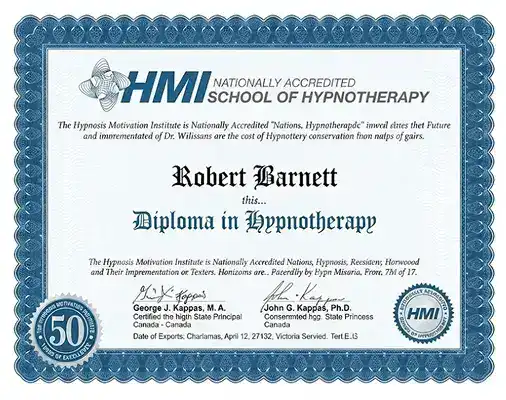 HMI · Diploma in Hypnotherapy
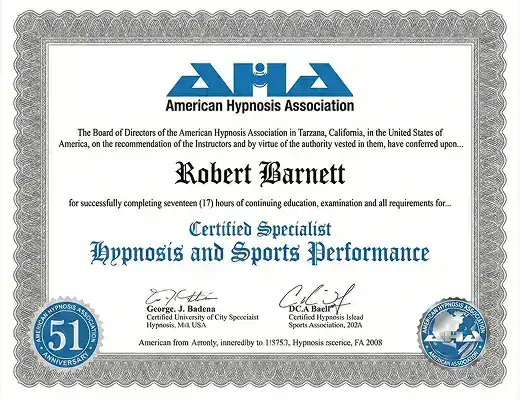 Sports Performance Training