
Equestrian mental coaching
Equestrian Mental Coaching & Rider Confidence
Private sessions by Zoom for riders of every discipline and level, from recreational to professional.
Book my free consultation20 minutes · No cost · No obligation

Work directly with Robert BarnettCertified Hypnotherapist · C.Ht., PMP, MBA

Free 20-minute consultation
No cost · No obligation · By phone
Your training is there. The question is whether it shows up when it counts: the in-gate, the first fence, the test in front of the judge, the first ride on a new horse. Riding is different from most sports: for many riders the anxiety is not limited to competition, and it can show up in lessons, schooling and everyday rides. You are also sharing the work with a horse, and horses are quick to react to changes in a rider's body, so nerves, doubt and overthinking can change the ride even when your skills are solid. Mental coaching and hypnosis train the skills that hold up under pressure: staying present, resetting after a mistake, and riding the plan you practiced. Robert Barnett, C.Ht., PMP, MBA, is a certified hypnotherapist and mental performance coach with 35+ years of hypnosis experience, and riders work with him by Zoom from anywhere. He works with riders from recreational to professional, across disciplines including show jumping, dressage, eventing and trail and recreational riding.
When the mental side matters
Sound familiar?
Riders of every level who:
Competition nerves
The warm-up feels good. Then the bell rings, your body tightens, and the ride feels different.
A fall or a setback
A fall, a refusal or a difficult ride shakes your confidence, and hesitation follows you back into the saddle.
A new horse
Changing horses means a new partnership, new reactions and a different rhythm to find.
Overthinking every stride
You second-guess distances, aids or decisions instead of riding the plan you practiced.
Pressure to get it right
Expectations, scores and comparison pull your attention away from your horse and the present moment.
Anxiety in everyday riding
The nerves are not only a show problem. They can show up in lessons, schooling and ordinary rides too.
The pattern behind it
Why your best riding doesn't always show up
Competition adds a judge, a score and an audience, but for many riders the stress response does not wait for the ring. Sitting on a large, powerful animal, a spooky moment or the memory of a fall can trigger the same automatic reaction in a lesson or a quiet schooling ride: tension, doubt, a loss of trust in your own aids. More hours in the saddle build skill, but they do not change that response, because it runs below conscious thought. That gap is what mental coaching works on.
In Robert's experience, riders who struggle with this are often skilled and well trained. Their riding is fine. The pattern that shows up under pressure is what needs to change.
The mental game plan
The solution: a mental plan built around your riding
The work usually follows three steps, shaped around your horse, your discipline and your goals:
Understand your pressure moments
We talk through what changes between a relaxed schooling session and a demanding ride, and identify the thoughts, sensations and situations that interrupt your confidence.
Rehearse a better response
Hypnosis and guided visualization work at the subconscious level, where automatic reactions live, so you can practice the focus and composure you want before you enter the arena.
Build a routine you can return to
You leave with personal cues for preparation, refocusing after a mistake, and returning your attention to the next part of the ride.
Hypnosis is a state of focused attention, and it is one tool among several. Most pressure reactions, such as tightening up on the approach to a fence, are automatic habits that run below conscious thought, which is why willpower and positive thinking rarely fix them. We combine hypnosis with complementary methods: cognitive behavioral techniques (CBT) to identify and restructure the thoughts that feed doubt, NLP methods to change how you picture and respond to pressure situations, and subconscious pattern work to replace old reactions with new ones. In Robert's experience, combining them gets results more quickly than any one alone. It is not mind control, and you stay in charge throughout.
Visualization is a core skill we teach, and we use it inside hypnosis. Research supports pairing skills: a 2025 meta-analysis of 86 studies found that imagery works better when combined with other psychological skills, which is why we pair it with hypnosis and cognitive tools.
Sessions are one-on-one by Zoom and take place off the horse, so you can work from anywhere. Everything is built around your horse, your riding experience and the situations that trip you up. Robert offers three program lengths and recommends one after your free phone consultation. In Robert's experience, the shortest is a starting point, since skills that hold up in competition usually take longer to build.
You start with a free 20-minute phone consultation. We talk through what happens when you ride and whether this is a fit. Your sessions are then held one-on-one by Zoom.
Mental coaching complements your trainer's guidance. It is not riding instruction, and it does not assess physical readiness or replace medical or mental health care. Progress is individual; results vary.
For the partnership, not just the placing
Be present for
the horse beneath you.
Every horse and discipline asks something different of a rider. Whether you are building a new partnership or developing an established one, the work is built around your riding, your goals and your trainer's work.
- A clearer mental routine before entering the arena
- A deliberate reset after a refusal or missed movement
- A plan for a new horse, or a return to confident riding
In their words
What riders say
High Performance Hypnotherapy has 65+ five-star reviews on Google. The review below is quoted as posted by the client.
“Very very helpful, very effective on many levels. Highly recommend.”
Google review from a rider. Individual experiences vary and results are not guaranteed.
More client stories are on our client reviews page.
More examples from recent riders
Client names and identifying details are left out to protect privacy.
Confidence with a new horse after a fall
A competitive dressage rider who froze when cantering a new horse learned that it was a stress response, not a skills gap. She built a personal anchor of three cue words tied to a powerful positive memory, practiced it with hypnosis, and used it on horseback to settle herself. She reported using it successfully while riding and kept making steady progress toward her competition goals.
Ready for a major competition
A high-level competitive rider preparing for a major competition worked on visualization, breathing and a calm, powerful anchor. She applied the tools consistently, saw steady gains in her riding and her confidence, and was very happy with her progress by the end of the program.
Back in the saddle after a setback
A rider coming back from a significant injury worked on turning the setback into a strength, with reframing, a daily gratitude practice and hypnosis. The rider finished the program positive and focused on returning to the saddle with the green light of their physical therapist.
Meet your mental coach
About Robert Barnett
Robert Barnett is a certified hypnotherapist (C.Ht.) with a PMP and an MBA. He has practiced hypnosis for more than 35 years and runs High Performance Hypnotherapy from Trumbull, CT, working with executives, business owners and competitive athletes worldwide. Learn more about Robert. Robert competed at a high level himself and knows sports anxiety from the inside: it built through years of competition, with teammates counting on him and his name in the local paper. He works with riders from recreational to professional level, and the conversation begins with your experience and the change you want to make.
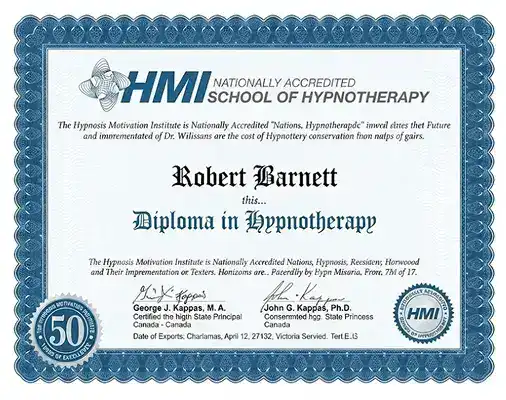 HMI · Diploma in Hypnotherapy
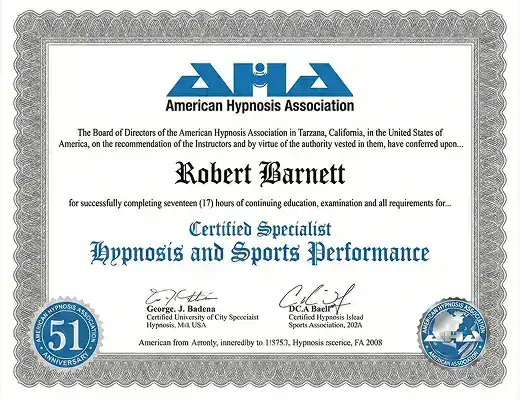 Sports Performance Training